Dyson runs a genuine large-scale farming business, but for decades UK farmland also carried an uncapped 100 per cent inheritance tax relief, which made it one of the most elegant IHT shelters available. That changed on 6 April 2026: combined Agricultural and Business Property Relief is now capped at £2.5m per person at full relief, with an effective 20 per cent charge above it. The same cap applies to shares in an ordinary trading company.
Singapore was the headline. It was also a red herring.
In January 2019, Dyson announced the company’s global head office was moving to Singapore. The Brexit-backing billionaire packing the head office off to Asia: the papers had a field day, and almost everyone took the wrong lesson. This was not the great tax escape. The company said the tax benefit was, their word, negligible. Dyson himself consistently said he remained a UK taxpayer.
Moving a head office abroad while the people, the engineering and the decisions stay in Britain does almost nothing for tax. A UK company is taxed on where it is genuinely managed and controlled, not where the headed paper says it sits, and a brass-plate move can create arguments rather than savings.
His personal position had its own small saga. Companies House filings showed his recorded country of residence flick to Singapore, then back to the UK in 2021, around the time he sold a Singapore penthouse for a reported £62m. That is a Companies House directorship field, not an HMRC residency determination, and throughout he maintained he was a UK taxpayer. So no, this is not the story of a man who cleverly fled the tax. The man came back. The real story is what he was buying the whole time.
Thirty five thousand acres
Since about 2013, Dyson has assembled a farming business of around 35,000 acres through Beeswax Dyson Farming, making him one of the largest private landowners in England, bigger on some measures than the late Queen.
There are good, genuine reasons for a manufacturer to run a serious farming operation, and his is real. But underneath British farmland sat a tax fact that the very wealthy understood long before everyone else. Agricultural Property Relief, with its cousin Business Property Relief, let qualifying farmland and business assets pass to the next generation with 100 per cent inheritance tax relief. No cap. You could hold hundreds of millions in qualifying land and, done properly, pass it on with the 40 per cent inheritance charge largely switched off. Tie up capital in working farmland and the Treasury’s claim on it more or less evaporated. That was the deal.
The cap with a deadline
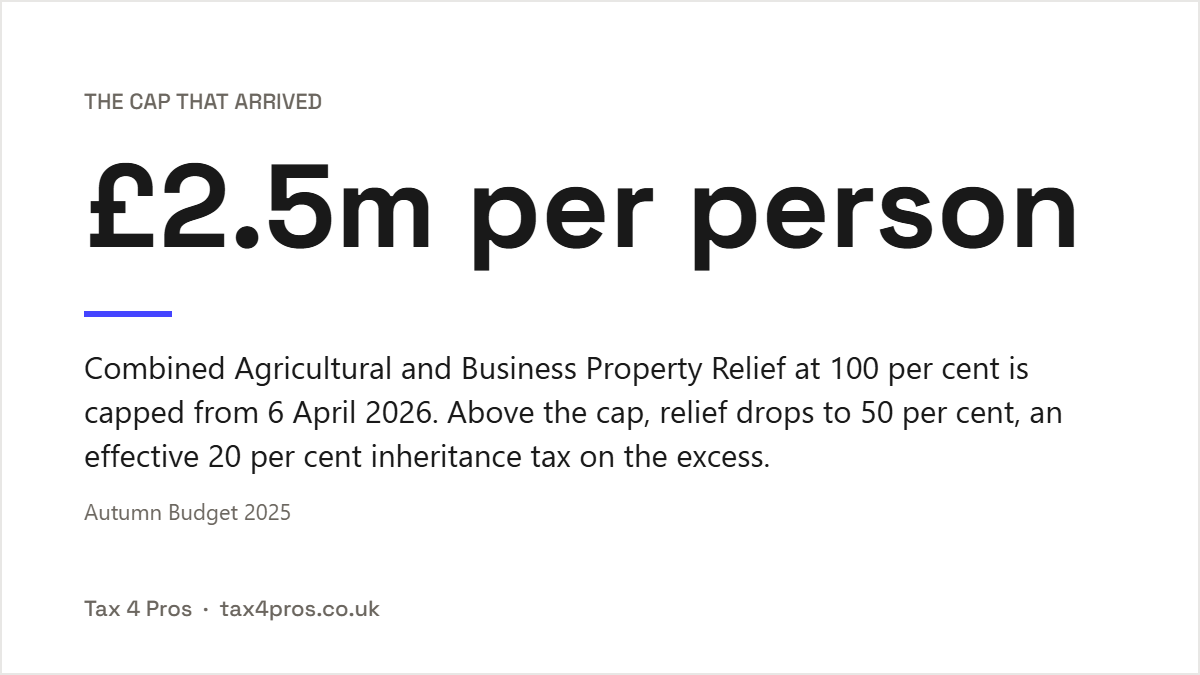
Since 6 April 2026, that uncapped relief has a ceiling. Combined APR and BPR is capped at £2.5m per person at 100 per cent relief. Above that, relief drops to 50 per cent, which means an effective 20 per cent inheritance charge on everything over the line. The cap is transferable between spouses, so a married couple who plan it properly can shelter up to £5m.
To most families, £2.5m per person is a serious number. To a man with 35,000 acres, it is a rounding error against the bill. Every acre he bought before the change was bought under a rulebook that said uncapped, 100 per cent, forever. The rulebook changed after the money was down, which is exactly why Dyson went to war over it.
The way it changed is instructive. Rachel Reeves announced a £1m cap at the Autumn Budget in 2024, farmers drove tractors through Westminster, and the Treasury compromised in its traditional style: it kept the tax and changed the number, settling on £2.5m from April 2026. Dyson called the original budget, his word, spiteful, and wrote that it would be the death of entrepreneurship. Worth noting for fairness: his op-ed predated the final £2.5m figure and was aimed at the £1m proposal.
He was angry because he has billions on the wrong side of that cap. You have two things he does not: time, and a much smaller number to plan around.

What this means for a UK company director
You are not buying 35,000 acres. Here is why this still matters.
That £2.5m allowance is the exact same relief that sits on your trading company. Business Property Relief on qualifying shares works the same way, and since April 2026 the value of your business above £2.5m per person no longer passes with full relief on death. It attracts the effective 20 per cent charge.
The genuine, legal lever is planning around the cap while there is time. Using both spouses’ allowances, so £5m between a couple rather than £2.5m. Genuine lifetime gifts, where the seven-year clock actually runs: a gift you survive by seven years falls out of your estate completely, but the clock only helps if you start it. Reviewing how the company is owned for the next generation while it can still be done properly.
The limit, stated plainly: none of this is free or instant. The relief was never magic. It always required real, qualifying assets and real ownership, and since April 2026 the shelter on the big numbers is largely closed. Plan early, or your family meets the 20 per cent charge at exactly the moment they would rather be grieving.
FAQ
Did James Dyson move to Singapore to avoid UK tax?
The record does not support that. The company said the tax benefit of the 2019 HQ move was negligible, and Dyson consistently said he remained a UK taxpayer. Companies House filings showed his recorded residence as Singapore for a period before reverting to the UK in 2021.
How much farmland does James Dyson own?
Around 35,000 acres, assembled since about 2013 through Beeswax Dyson Farming, making him one of the largest private landowners in England. His net worth was estimated at around £20bn by the Sunday Times Rich List 2025. Both are estimates rather than audited figures.
What is the APR and BPR cap from April 2026?
Combined Agricultural and Business Property Relief at 100 per cent is capped at £2.5m per person for deaths and transfers from 6 April 2026. Above the cap, relief falls to 50 per cent, an effective 20 per cent IHT charge. The cap is transferable between spouses, giving up to £5m per couple.
Does the £2.5m cap affect ordinary business owners or just landowners?
It affects both. The cap is a combined limit across agricultural and business property, so shares in a qualifying trading company sit under the same £2.5m ceiling. A company worth more than £2.5m per owner now carries an effective 20 per cent IHT exposure on the excess unless the estate is planned.
Tax 4 Pros works with limited company directors on exactly this: reviewing how the company and the estate are structured and planning around the cap before the deadline does the planning for you. Apply to work with us at apply.ctprivateoffice.com.
Sources
- Al Jazeera, “Brexit-backer Dyson moves company’s main office to Singapore”, 23 January 2019; CNN, 22 January 2019 (HQ move; “negligible” tax benefit, Jim Rowan)
- Bloomberg and City AM, 21 April 2021 (Companies House residence field; ~£62m Singapore penthouse sale)
- Fortune, 4 November 2024; Who Owns England, Land Registry and Farmers Weekly data (~35,000 acres, Beeswax Dyson Farming)
- Sunday Times Rich List 2025 (net worth ~£20bn, estimate)
- The Times, Dyson op-ed, 4 November 2024 (“spiteful”; written against the original £1m proposal)
- HMRC and gov.uk, APR and BPR reform explanatory notes; Autumn Budget 2025 (£2.5m cap from 6 April 2026, spouse-transferable)