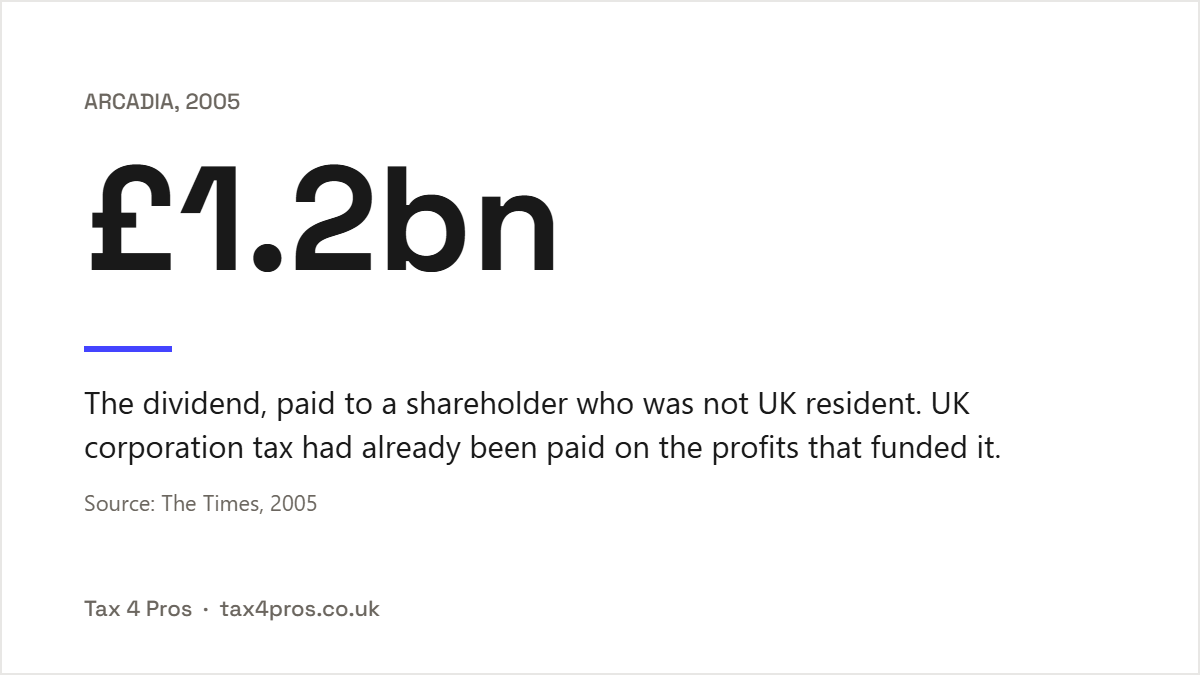
In 2005 Arcadia, the company behind Topshop, paid a £1.2bn dividend, the largest in British corporate history, to Tina Green, a genuine Monaco resident since 1998. UK rules treat a non-resident’s UK dividend income as disregarded, the UK deducts no tax at source on dividends, and Monaco charges residents no personal income tax. Corporation tax was still paid inside the company. Only the extraction layer disappeared.
The owner who wasn’t here
Sir Philip Green ran Arcadia: Topshop, Topman, Burton, Dorothy Perkins. A very British high street empire, earning British profits and paying British corporation tax. But Sir Philip was not the registered owner. His wife, Tina Green, was, and she had lived in Monaco since 1998.
So when Arcadia declared its £1.2bn dividend in 2005, the money went to a Monaco resident. The company was here. The shareholder was not. That single fact is the whole story.
How the mechanism actually worked
Two rules stacked together.
First, when a non-UK resident receives a UK dividend, the disregarded income rules (now in ITA 2007) apply. The UK does not deduct tax at source on dividends, and under these rules the UK income tax a non-resident owes on them is effectively capped at nothing. That is the actual statutory position, using the actual statutory word: disregarded.
Second, Monaco then takes nothing either, because Monaco charges its residents no personal income tax. UK, zero. Monaco, zero. The money lands clean.
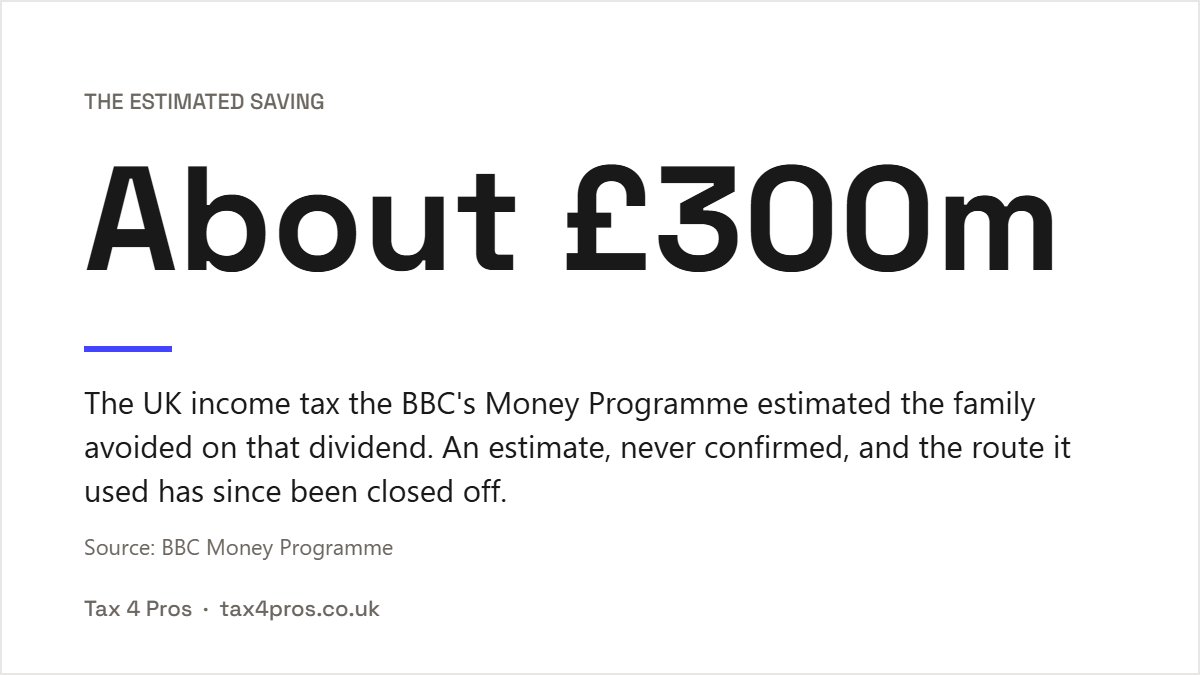
Now the part that bad content always skips, and the part that matters most. That £1.2bn was not magically untaxed. Arcadia was a UK company and paid UK corporation tax on the profits underneath the dividend, the same as any British company. What the Monaco arrangement removed was the second layer: the income tax on extraction that a UK resident shareholder would have paid on taking the money out. The BBC’s Money Programme estimated the family saved around £300m of UK income tax this way. That is a broadcaster’s estimate rather than an HMRC figure, so treat it as a ballpark, but note what it measures: the saving on the extraction layer only. The corporation tax was paid either way.
Why you can’t just copy it
This is not a switch you flip by gifting your shares to your spouse on Monday.
The settlements rules. If you divert income to a lower-taxed spouse, section 624 of ITTOIA 2005 and the legislation around it exists specifically to catch that. The arrangement only escapes where the gift of shares is a genuine, outright transfer of real ownership, ordinary shares with full rights, no strings, and no quiet arrangement routing the money back. Tina Green passed that test because it was real: she genuinely lived in Monaco, and she was genuinely the owner. Substance, not paperwork.
The residence regime has changed. From 6 April 2025 the old non-dom system is gone. Domicile no longer decides UK tax; residence does. For inheritance tax, anyone UK resident for 10 of the last 20 tax years has their worldwide estate in the UK net, with a tail of up to 10 years after leaving.
The five-year rule. Go non-resident, strip a large distribution out of your close company, and return within five tax years, and HMRC can tax it on your return. The carve-out that used to soften this, dividends paid from profits earned after departure, was abolished from April 2026. The old idea of leave, empty the company, come home used to half work. It now fails in full.
So in 2005, on those facts, with a genuinely Monaco-resident owner, the arrangement was lawful and it worked. It also drew years of public anger, which is a separate question from legality. Today, with a UK resident spouse and a token move, the same idea falls apart at every gate. The difference, every time, is whether the arrangement is real.
The lever for a UK company director
You are not Sir Philip Green, so what is the transferable lesson? It is this: who owns your shares, and where they genuinely live, decides the tax on extraction. Ownership and residence, backed by real substance, do the work that no clever one-year scheme can.
For most owners the lever is not an offshore spouse. It is the structuring available while you are here. How much profit you retain versus extract, since retained profit is taxed once at corporation tax rates while extraction adds a second layer. Whether a holding company makes genuine commercial sense. Your salary and dividend mix. Pension contributions. Shares can sit with a spouse, but only as a genuine outright gift of ordinary shares that the settlements legislation respects.
The limit, stated plainly: every layer of this now has a gate on it. The settlements rules, the residence-based regime, the five-year rule. Build something real and it stands. Build something clever and thin, and it does not.
FAQ
Was the £1.2bn dividend tax free?
No. Arcadia paid UK corporation tax on the profits behind it. The dividend itself carried no UK income tax because the recipient was a genuine non-resident, and no Monaco tax because Monaco charges none. The saving was on the extraction layer only.
Was it legal?
Yes, on the facts as reported. The disregarded income rules and the absence of UK withholding on dividends are statutory. It was lawful at the time and still attracted significant public criticism, which is a reputational question rather than a legal one.
Can I put my company shares in my spouse’s name to save tax?
Only as a genuine, outright, no-strings gift of ordinary shares with full rights. The settlements legislation catches arrangements that are really about shifting income while keeping control. Dividend-only share classes and gifts with conditions attached fail.
Would the Green structure still work today?
The core rules on non-resident dividends still exist, but the surrounding regime has tightened. The non-dom system ended in April 2025, the five-year temporary non-residence rule catches returners, and the post-departure profits carve-out was abolished from April 2026. A genuine, lasting, substantive move remains the only version that stands.
What should a normal company director take from this?
That extraction is where the second layer of tax lives. Retained versus extracted profit, salary and dividend mix, pensions and genuine ownership structure are the levers most directors actually have, and they need to be real to survive scrutiny.
Work with us
Tax 4 Pros handles the accounts, VAT and compliance for UK limited company directors, and CT Private Office builds the structures that hold up when someone checks. Apply to work with us at apply.ctprivateoffice.com.
Sources
- The Times, 2005 (via Wikipedia, “Tina Green”): the £1.2bn Arcadia dividend
- The Guardian, 2020: Tina Green’s Monaco residence since 1998
- BBC Money Programme estimate (via taxresearch.org.uk, 2006): ~£300m UK income tax saved
- ITA 2007 Part 14 (disregarded income); HMRC SAIM1170
- ITTOIA 2005 ss624 to 626; HMRC TSEM4205: settlements legislation
- Finance Act 2025: residence-based regime from 6 April 2025
- HMRC HS278; gov.uk policy paper, 26 November 2025: temporary non-residence and the post-departure profits abolition