Gary Lineker won because IR35 requires an intermediary between the worker and the client, and he did not have one. He worked through a partnership, not a company, and signed every contract personally, creating direct contracts with the BBC and BT Sport. The tribunal ruled in March 2023 that IR35 “does not, and cannot as a matter of law, apply”. HMRC appealed, then withdrew in December 2024. The amount genuinely in dispute was roughly £300,000 to £400,000 in National Insurance, not £4.9 million.
The case HMRC brought
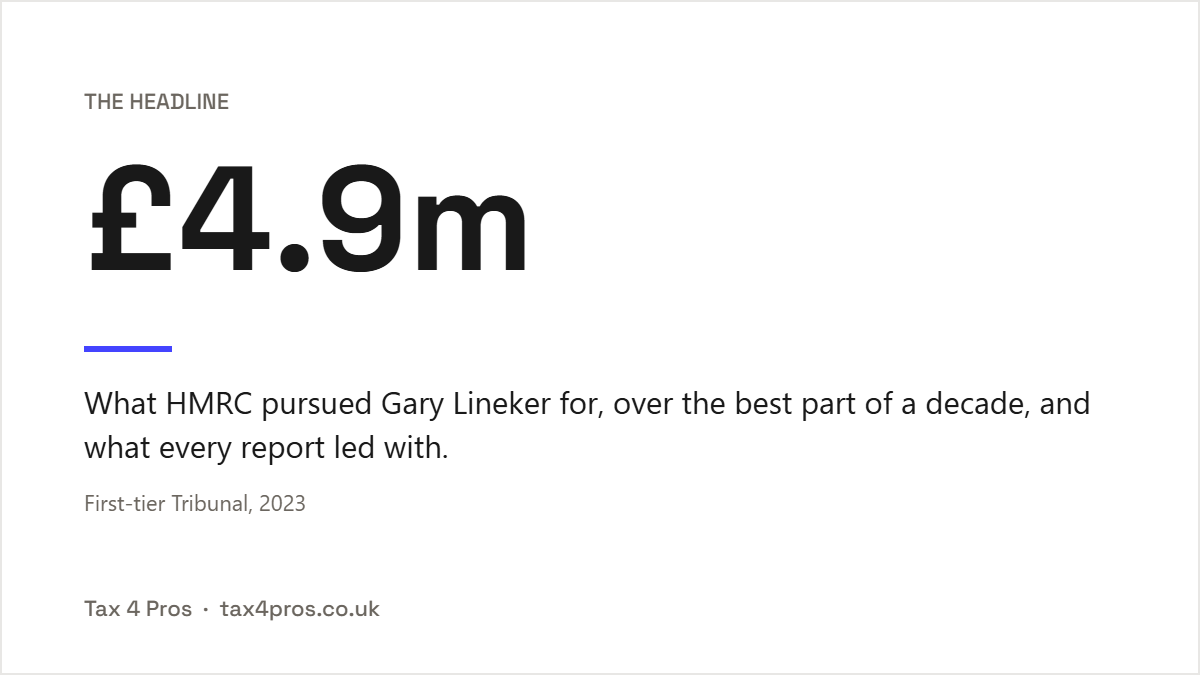
Lineker was the BBC’s highest paid presenter: Match of the Day, the crisps, the lot. For the best part of a decade, HMRC pursued him for £4.9 million in income tax and National Insurance covering his BBC work from 2013 and his BT Sport work from 2015 to 2018.
The weapon was IR35, the intermediaries legislation. The rule says that if you work through your own entity but the reality of the relationship looks like employment, they control your hours, you cannot send a substitute, the work keeps coming regardless, then HMRC can tax you like an employee. Full income tax, full National Insurance, with the wrapper ignored.
HMRC looked at Lineker’s broadcasting work and said: that is employment in everything but name. Pay up.
The detail that decided everything
Most IR35 cases involve a personal service company, a limited company with one director. Lineker did not have one. He worked through Gary Lineker Media, a general partnership under the Partnership Act 1890 between him and his then wife, Danielle Bux. Not a company. A partnership, governed by a statute from 1890.
That detail decided the whole case. Because Gary Lineker Media was a partnership rather than a company, Lineker had signed every contract himself, as a partner. Legally, that created direct contracts between Lineker and the BBC, and between Lineker and BT Sport.
IR35 only applies where an intermediary sits between the worker and the client. It is literally the name: the intermediaries legislation. In the First-tier Tax Tribunal, Judge John Brooks heard three days of argument and delivered the decision on 28 March 2023. Because there were direct contracts, the legislation “does not, and cannot as a matter of law, apply”. Not “on balance”. Not “weighing the factors”. The legal equivalent of the referee ruling the match never kicked off.
The real number
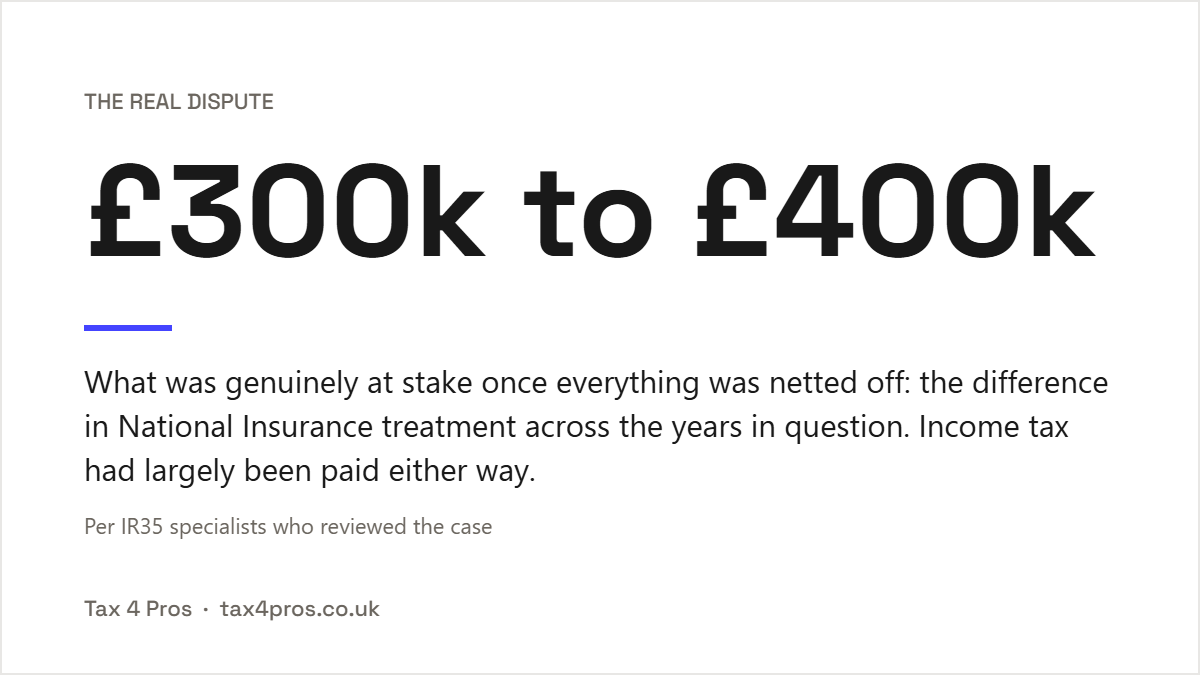
Here is what the headlines never bothered with. The £4.9 million was never really the number. Lineker had already paid income tax on this income personally, through the partnership, at his marginal rates. What remained genuinely in dispute, once everything was netted off, was the difference in National Insurance treatment: roughly £300,000 to £400,000 across the years in question, according to IR35 specialists who reviewed the case.
He had paid his tax. The eight-year fight was about which type.
The quiet surrender
A ruling of “cannot as a matter of law” is a strong hint, but HMRC appealed anyway, taking the case to the Upper Tribunal in June 2023. Then, in December 2024, days before the hearing, HMRC withdrew and settled. Quietly. No press release, no apology, terms confidential.
Roughly eight years passed from the first enquiry to the quiet settlement, against a man with the resources to fight and a structure that happened to be legally watertight. That is the part worth sitting with. Lineker could afford eight years of tax counsel. Most company directors cannot, and settle because years of legal fees are their own punishment. The process is the punishment, and HMRC will run it to the final whistle.
What decides IR35 when it does apply
Lineker escaped on structure. When an intermediary does sit in the chain, which is the position of almost every contractor with a limited company, the case turns on three decades-old factors:
- Control. Does the client decide when, where and how you work?
- Substitution. Could you genuinely send someone else to do the work?
- Mutuality of obligation. Must they offer work, and must you accept it?
Every presenter case in the news, the wins and the losses, turns on those three. Same sofa, opposite verdicts, and the difference is never the celebrity. It is the paperwork and the working practices underneath it. The winners had contracts reviewed before the enquiry and working practices that matched the paper. The losers had “standard” contracts nobody read and day-to-day practices that contradicted every clause.
Two things to be clear about. A partnership is not a magic IR35 cloak: what worked for Lineker was specific to broadcasting contracts signed personally, and copying the wrapper without the facts achieves nothing. And the off-payroll rules have shifted since his years under enquiry: for medium and large private sector clients and all public sector clients, the client now decides status, and since 6 April 2024 HMRC offsets the tax already paid through the company when settling an IR35 liability, rather than charging full deemed PAYE on top.
What this means for a UK company director
If you invoice anyone through your own company, this case is about you, and the takeaway is unglamorous. Lineker won because his structure and his contracts matched reality before anyone came asking. That is not luck, that is the whole game.
So the question worth answering now: when did anyone last read your contracts against your actual working practices? Not when you set up. Now. HMRC does not write to ask how you are getting on. The letter, when it comes, is the kickoff.
FAQ
Did Gary Lineker avoid £4.9 million in tax?
No. He had already paid income tax on the income personally through his partnership. The genuine dispute was the difference in National Insurance treatment, roughly £300,000 to £400,000, and the tribunal found IR35 could not apply to him at all.
Does using a partnership avoid IR35?
Not as a general rule. Lineker’s case turned on the fact that he signed his broadcasting contracts personally, creating direct contracts with the BBC and BT Sport, which left no intermediary for IR35 to attach to. The same wrapper with different facts could still be caught.
What decides a normal IR35 case?
Three factors: control (who decides when, where and how you work), substitution (whether you could genuinely send someone else) and mutuality of obligation (whether work must be offered and accepted). Working practices matter as much as the written contract.
Who decides IR35 status now?
For medium and large private sector clients and all public sector clients, the client decides. Contractors decide for themselves only when the client is a small private sector business. Since April 2024, HMRC also offsets tax already paid through the company when settling a liability.
Tax 4 Pros reviews structures and contracts for UK limited company directors before HMRC ever starts the clock, the boring, defensible kind of planning that HMRC reads and moves straight past. Apply to work with us at apply.ctprivateoffice.com.
Sources
- First-tier Tax Tribunal, Gary Lineker and Danielle Bux t/a Gary Lineker Media v HMRC, decision 28 March 2023 (Judge John Brooks)
- HMRC appeal to the Upper Tribunal, June 2023; withdrawal and confidential settlement, December 2024
- IR35 specialist commentary on the sums actually in dispute (NICs difference of roughly £300,000 to £400,000)
- Partnership Act 1890 (the legal form of Gary Lineker Media)
- HMRC Employment Status Manual and Finance Act 2024 (the PAYE and corporation tax offset from 6 April 2024)