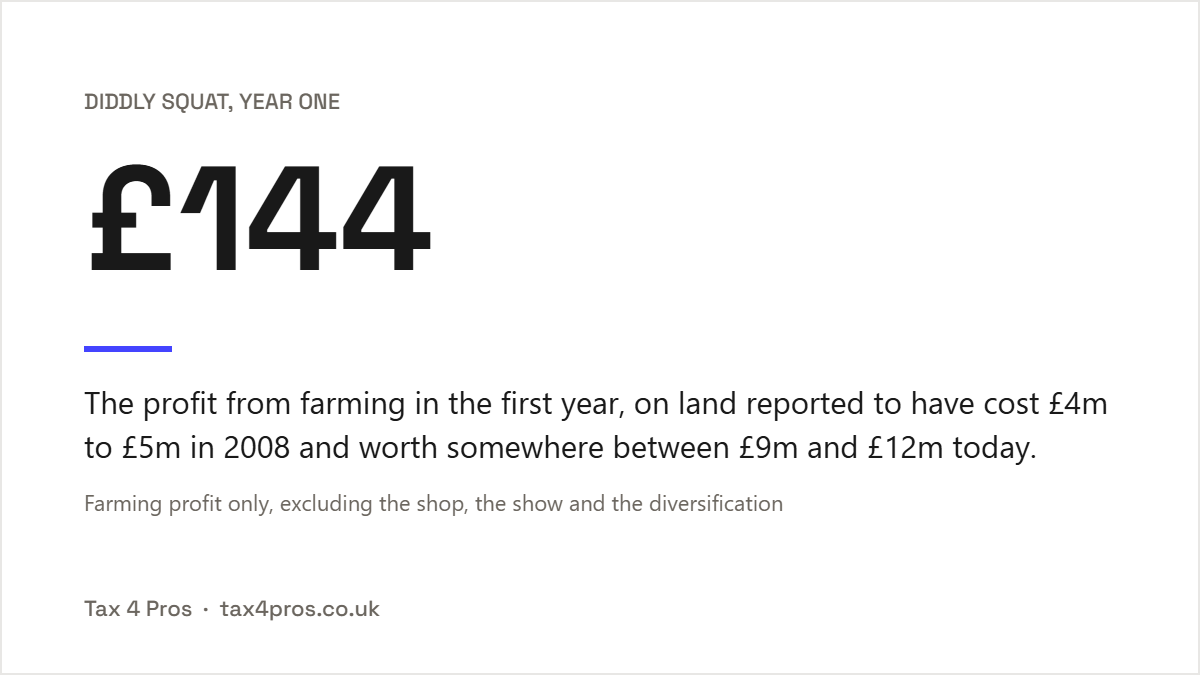
Not the farming. Diddly Squat made £144 profit in its first year as a farm. What works is everything built on top of the land: the farm shop, The Farmer’s Dog pub, and above all the Amazon Prime show itself. The land, meanwhile, has roughly doubled in value since Clarkson bought it. The crop is the story. The brand and the asset are the business.
What Clarkson actually owns
Diddly Squat Farm is around 1,000 acres near Chipping Norton in Oxfordshire. Clarkson bought it around 2008 for a reported £4m to £5m, fairly typical for quality Oxfordshire farmland at the time.
Since then the land has done something remarkable, entirely passively. Savills’ rural research puts prime arable land in the South Midlands at roughly £9,000 to £12,000 per acre in recent years. At 1,000 acres, that is an asset now worth somewhere between £9m and £12m. He bought it for £4m to £5m. It has roughly doubled without growing a single profitable crop.
The farming itself is a different picture. Year one produced £144 of profit. On an asset worth £9m to £12m, that is not a good return or a bad return. It is not, in any meaningful sense, a return at all. A savings account would have beaten it without the 5am starts. And the structural economics have not dramatically improved since, because for most British arable farms they cannot: the crop is not the business. The crop is the justification for owning the land.
The three things that do work
The farm shop. Diddly Squat Farm Shop opened in 2020 and has run with queues down country lanes and a national merchandise operation ever since. One point of honesty here: Clarkson’s farm companies file abbreviated accounts at Companies House, which is normal at that company size, so no confirmed turnover figure is public. What is visible is commercial evidence of a significant trading business. The benchmark for this model is Daylesford Organic in the Cotswolds, where the farm itself is loss-making but the shop, cafes and branded lines generate revenues many multiples of what any crop could. The farm is the story. The retail is the margin.
The pub. The Farmer’s Dog opened in August 2024. It extends the visit, the day out and the spend. Again, no filed accounts at this scale give a precise figure, but it is a commercial operation attached to a national brand, not a gesture.
The show. Clarkson has said in his Sunday Times column, paraphrasing rather than quoting, that the content generates far more than the farming ever could, and that he could sell the land and earn more from the interest. The £144 was not a failure. It was the inciting incident of a television series. Viewers thought they were watching a farm. They were watching a media operation in a field. Arguably the most profitable crop in the history of British agriculture.
The real playbook for British farms
Most arable farms in Britain survive on government payments. The Basic Payment Scheme is being phased out in favour of Defra’s Sustainable Farming Incentive, which pays for environmental actions rather than land ownership: SAM1 (arable soils) pays £28 per hectare, SAM2 pays £70 per hectare, per the published 2024 rates. A committed farm of around 400 hectares can generate an illustrative £50,000 to £100,000 plus in SFI payments, depending entirely on which actions it signs up for. Strip those payments out and AHDB Farm Business Survey data shows most commercial arable farms in England are loss-making.
What actually generates profit on a diversified farm in 2026:
- A farm shop with a genuine brand and footfall
- Glamping and farm stays, which can return 15 to 25 per cent on the capital invested
- Ground-mounted solar leases, commercially reported at £500 to £1,000 plus per acre per year over 25-year terms
- Weddings and events in converted barns, at £5,000 to £15,000 per event
- Holiday lets from Class Q building conversions
- Biodiversity Net Gain credits, currently trading at roughly £20,000 to £30,000 per unit on qualifying land, in a market that is still forming
The profitable farms in Britain are overwhelmingly the ones that stopped trying to profit from farming a decade or more ago. The land is the vehicle. The diversification is the business.
The tax trap in the middle of the dream
Here is the part almost nobody selling the diversification dream mentions.
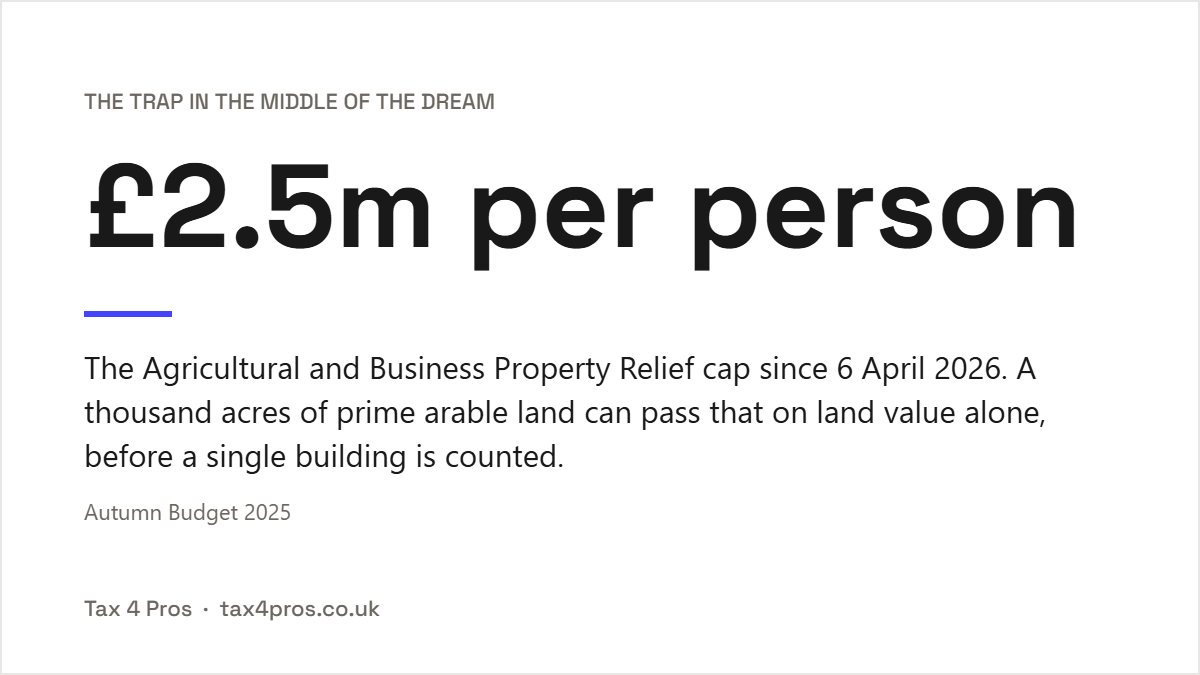
Agricultural land qualifies for Agricultural Property Relief on inheritance tax. Since 6 April 2026, the combined APR and Business Property Relief at 100 per cent is capped at £2.5m per person (transferable between spouses, so up to £5m per couple). Above the cap, relief drops to 50 per cent, an effective 20 per cent IHT charge on the excess. Within the cap, qualifying agricultural land still gets full relief.
The catch is the word qualifying. Farm shops might qualify for BPR as genuine trading businesses, but HMRC looks at what the business actually does, not what it calls itself. Glamping and events are fact-specific. Solar is where it gets genuinely nasty: HMRC has argued that land under a solar lease has changed character, from agricultural land producing agricultural output to investment land generating rent, and investment property does not qualify for APR. You could earn £500,000 a year from a solar site for 25 years and then find the estate valuation treats those acres as taxable investment property. That can be millions of pounds of IHT exposure on land you thought was sheltered. BNG credits raise a similar character question, and HMRC is watching that market closely.
So the sequencing matters enormously. Which entity owns what, how trading income flows, whether the agricultural character of the land is preserved as the revenue diversifies. Get the structure right before you diversify. Once the income flows are set the wrong way, unwinding them is expensive, slow and often only partly possible. Clarkson, for all the on-screen chaos, has advisers and a structure: the farm companies are separate from the television income, the shop is a trading business, the land is held in the right names. That is planning, and it is available to any farm diversifying in the right order.
FAQ
Did Clarkson’s farm really only make £144?
Yes, in its first year as a farming operation, as shown in series one of Clarkson’s Farm and confirmed across multiple press reports. Clarkson has never disputed it. The farming has not dramatically improved since, which reflects the economics of British arable farming generally rather than mismanagement.
Is farmland still inheritance tax free?
Only up to a point. Since 6 April 2026, 100 per cent Agricultural and Business Property Relief is capped at a combined £2.5m per person. Above that, relief halves, which means an effective 20 per cent IHT charge on the excess. Couples who plan properly can shelter up to £5m between them.
Do solar panels affect a farm’s inheritance tax position?
They can. HMRC has argued that land leased for solar is investment property rather than agricultural property, which would remove APR on those acres. The position is fact-specific and not settled law, so take specialist advice before signing a solar lease, not after.
What is the most profitable way to diversify a farm?
It depends on the land and the capital available. Farm shops with genuine brands, solar leases, glamping, barn events and BNG credits all outperform arable margins. The common thread is that each one changes the tax character of the income or the land, so the ownership structure needs designing before the first agreement is signed.
Tax 4 Pros works with company directors and landowners on exactly this: structuring businesses and assets properly before the income flows are set, not after. If that sounds like your situation, apply to work with us at apply.ctprivateoffice.com.
Sources
- Clarkson’s Farm, Amazon Prime Video, series 1 (the £144 year one profit; confirmed by The Guardian, The Times, The Telegraph)
- Savills Rural Market Review 2024 (South Midlands arable values, published Q1 2025)
- Companies House filings, Clarkson’s farm-related entities (abbreviated accounts, June 2026)
- Defra, Sustainable Farming Incentive scheme guidance, 2024 payment rates (gov.uk)
- AHDB Farm Business Survey, England, 2023/24
- Savills, Carter Jonas, NFU Energy (solar lease ranges); NFU and CLA (glamping returns)
- CIEEM, Savills BNG briefings, Natural England guidance (BNG credit pricing, 2024)
- HMRC Inheritance Tax Manual, IHTM24000 series; Autumn Budget 2025 (£2.5m APR/BPR cap from 6 April 2026)