Richard Branson pays no UK tax on his non-UK income because he stopped being a UK tax resident. The UK taxes residents on worldwide income; a genuine non-resident is only taxed on UK-source income. The British Virgin Islands then charges no income tax, capital gains tax or inheritance tax, so no replacement bill arrives. The mechanism is UK law, and it is open to anyone who genuinely leaves.
The man on the island
Branson bought Necker Island in the late 1970s, when he was 29, as an uninhabited rock on the edge of the British Virgin Islands. Around 2006 to 2007 he moved there permanently. His net worth sits somewhere around $2.8 billion on Forbes’ estimate, a figure that moves daily, attached to a business empire earning income all over the planet.
His own explanation, given word for word, is that he and his wife did not leave Britain for tax reasons but for their love of the BVI. Take him at his word or raise an eyebrow, it makes no difference to the tax analysis. The rules produce the same result whatever the motive.
What actually switches off the UK tax
This is the part the internet routinely gets wrong. The saving does not come from the island having no tax. Plenty of places charge no tax, and living in one of them saves a UK resident precisely nothing, because the UK taxes its residents on their worldwide income. Every pound, earned anywhere, however it is banked.
The saving comes from one thing: Branson is no longer a UK tax resident. Once you genuinely cease UK residence, the UK stops taxing your worldwide income. Only then does a zero-tax jurisdiction matter, because the money lands somewhere that does not tax it either. You need both halves. The zero-tax island is useless without the non-residence.
And you do not get to simply declare yourself gone. Residence is decided by HMRC’s Statutory Residence Test, a mechanical set of day counts and connection tests introduced in 2013.
The catch that follows you out
The Statutory Residence Test is strict, and it does not care how nice your beach is.
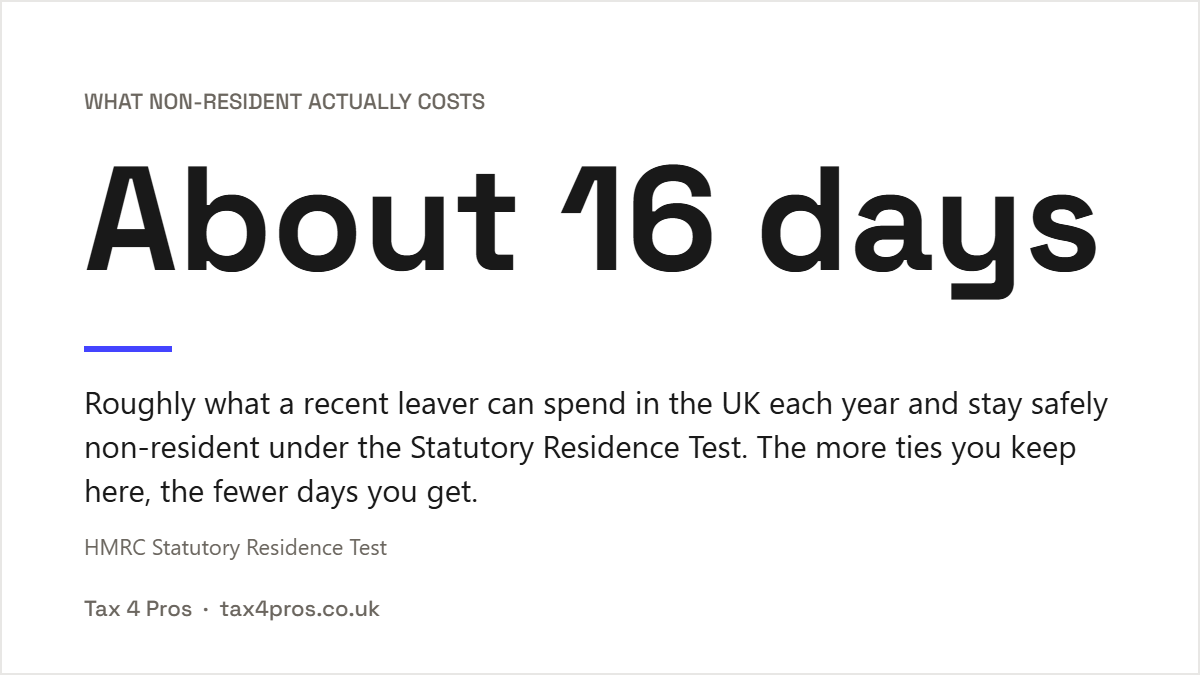
Broadly, someone who has been UK resident in recent years must keep their UK days under about 16 a year to be safely non-resident. HMRC counts midnights: where you slept, night by night. Alongside the day counts sit the ties tests. A home here that is available to you, close family here, substantial work here, a history of 90 plus UK days in recent years. The more ties you keep, the fewer days you are allowed. That is why Branson genuinely lives on the island. It is a real life abroad, and that is what makes it stand up.
Then come the catches most coverage forgets.
First, UK-source income is still taxed. Leaving protects your foreign income. A UK rental property or UK work remains taxable in the UK regardless of where you live.
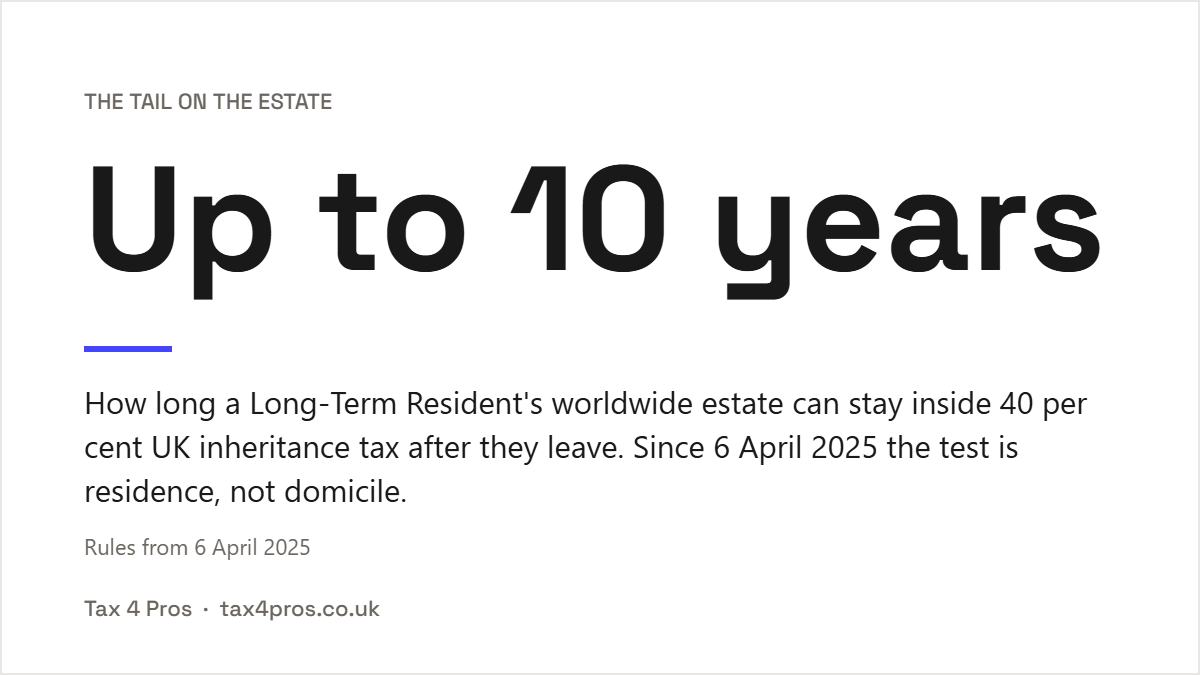
Second, the inheritance tax tail. Since 6 April 2025, inheritance tax follows residence rather than the old concept of domicile. Anyone who was UK resident for 10 of the previous 20 tax years is a long-term resident, and their worldwide estate stays within 40% UK inheritance tax for up to 10 tax years after they leave. Income tax stops when you genuinely go. The estate exposure can follow you for a decade.
Third, do not come back too soon. Sell up, leave, and return within five tax years, and gains realised while away can be pulled straight back into UK tax under the temporary non-residence rules. The move has to be real, and it has to last.
What this means for a UK company director
The lever in this story is residence, and it applies to any UK limited company owner, whatever the size of the business. The single biggest tax decision you will ever make is where you are tax resident. That one switch decides whether the UK taxes your worldwide income at all.
But the lever carries a price tag. You have to actually leave, and keep leaving, year after year, under a day-counted regime. You lose UK reliefs. Your UK-source income stays taxed. And the inheritance tail follows you out for up to 10 years.
There is also a timing point worth being honest about. Branson left around 2007 under the old domicile rules, when a clean break was quicker. The income tax side works the same today, but the estate side got slower in April 2025, the old route of leaving, emptying the company and returning was shut in full from April 2026, and from 6 April 2027 most unused pension pots come into the estate for inheritance tax as well. The method has not changed. The timing has, and each rule change has moved in the same direction.
The honest conclusion
Branson’s arrangement holds up for one reason: it is real. He genuinely left and genuinely lives there, so there is no trick for HMRC to unpick. For most UK directors the right answer is not a plane ticket. It is structuring the UK business and the estate properly, with every cost counted, and making the stay-or-go decision deliberately rather than by accident.
FAQ
Does Richard Branson pay any tax at all?
He pays whatever tax arises where income is sourced. What he does not pay is UK tax on non-UK income, because he is not UK resident. Any UK-source income a non-resident has, such as UK rent, remains taxable in the UK.
Can I just move abroad and stop paying UK tax?
Only if you genuinely cease UK residence under the Statutory Residence Test. That typically means fewer than about 16 UK days a year at first if you were recently resident, and shedding UK ties such as an available home, family and work here. A postal address abroad achieves nothing.
Does leaving the UK avoid inheritance tax?
Not quickly. Since 6 April 2025, a long-term resident (UK resident in 10 of the previous 20 tax years) stays within UK inheritance tax on their worldwide estate for up to 10 tax years after leaving.
What happens if I leave and then come back?
Return within five tax years and gains realised while away can be taxed on your return under the temporary non-residence rules. From April 2026 the carve-out for dividends paid from post-departure company profits was abolished too, so a short round trip no longer works.
Is any of this illegal or aggressive avoidance?
No. Residence is the basis on which the UK charges tax, set out in statute. Genuinely changing residence changes the charge. The failures happen when people pretend to leave while keeping their life here.
Work with us
Tax 4 Pros looks after the accounts, tax and structuring of UK limited company directors, with CT Private Office handling advisory work like residence and estate planning. If you want this thought through properly on your own numbers, apply to work with us at apply.ctprivateoffice.com.
Sources
- Forbes, 20 April 2020: Branson’s statement on leaving Britain (via Virgin.com)
- South China Morning Post, 14 October 2013: Branson interview on Necker residence
- Forbes real-time billionaire profile, 30 June 2026: net worth estimate (~$2.8bn)
- HMRC RDR3: Statutory Residence Test guidance, gov.uk
- Finance Act 2025 s.44 and Sch.13; HMRC IHTM47020: residence-based IHT and the leaver’s tail
- HMRC HS278: temporary non-residence rules
- gov.uk policy paper, 26 November 2025: abolition of the post-departure trade profits carve-out